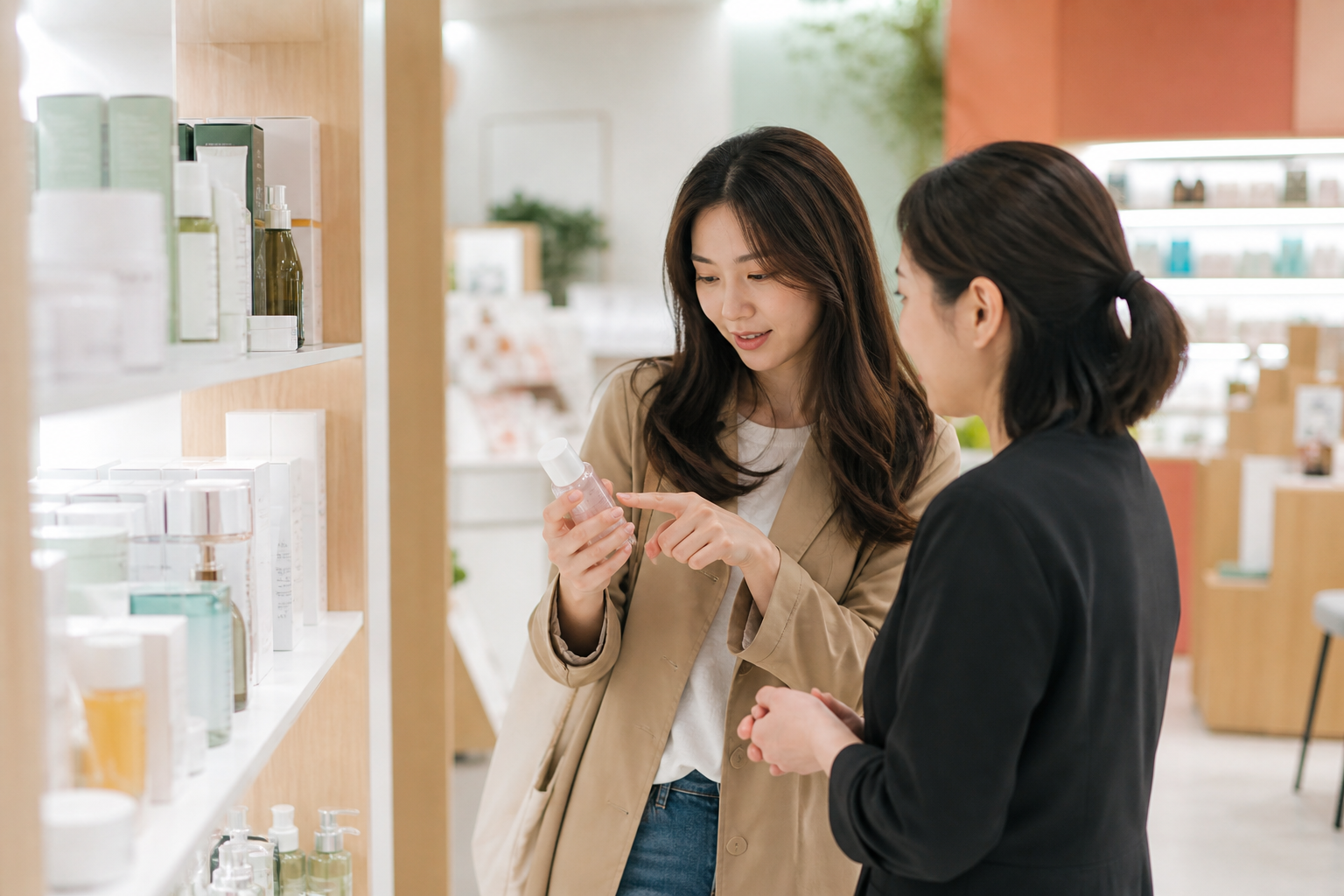
If you’ve ever picked up a Korean skincare product and felt a little lost between the Hangul and the Konglish, you’re not alone. Korean beauty labels use a specific vocabulary — some borrowed from English, some purely Korean — that shows up again and again once you know what to look for. Here are 10 terms worth learning so you can shop with confidence.
1. 에센스 (esenseu) — essence
Not the same as a serum, even though Western brands often use the words interchangeably. A Korean essence is lighter, sits between toner and serum in a routine, and is meant to boost hydration and help the rest of your routine absorb better.
2. 앰플 (aempul) — ampoule
A concentrated, potent version of a serum — usually used short-term or for a specific concern (brightening, calming, etc.) rather than as a daily staple. Think of it as the “treatment” step.
3. 진정 (jinjeong) — “soothing” / “calming”
You’ll see this a lot on products meant to calm redness or irritation. If a label says 진정, it’s signaling the product is gentle and calming-focused, often centered on ingredients like centella or aloe.
4. 수분 (subun) — “moisture” / “hydration”
A very common word for water-based hydration, as opposed to 영양 (yeongyang, nutrition/nourishment), which usually signals richer, more emollient formulas.
5. 미백 (mibaek) — “brightening”
Despite the literal translation leaning toward “whitening,” in modern K-beauty marketing this almost always means brightening/evening tone — not skin lightening in the way the literal translation might suggest to English speakers.
6. 탄력 (tallyeok) — “elasticity” / “firmness”
Common on anti-aging or firming products. If you see this alongside collagen or retinol-adjacent ingredients, it’s an anti-aging-focused product.
7. 저자극 (jeojageuk) — “low irritation” / “gentle”
A reassurance label similar to “hypoallergenic” in Western marketing — often paired with sensitive-skin lines.
8. 크림 (keurim, cream) vs 로션 (losyeon, lotion)
Straightforward, but worth knowing the distinction holds in Korean routines too — lotion is lighter and more fluid, cream is heavier and used as a sealing step.
9. 팩 (paek) — pack
This refers to masks — but “sheet mask” specifically is usually 시트팩 (siteupaek), while a wash-off clay or gel mask is often just called 팩 or 마스크팩 (maseukeupaek).
10. 올인원 (orinwon) — all-in-one
A convenience label for multi-step-in-one products, popular in simplified routines. Handy to know if you’re short on time but still want the multi-step benefits.
Quick tip: Once you recognize 에센스, 앰플, and 진정, you’ll be able to navigate most Korean skincare shelves — whether you’re shopping in Seoul, ordering online, or reading ingredient lists on imported products.
Put the words to work: a shopping scenario
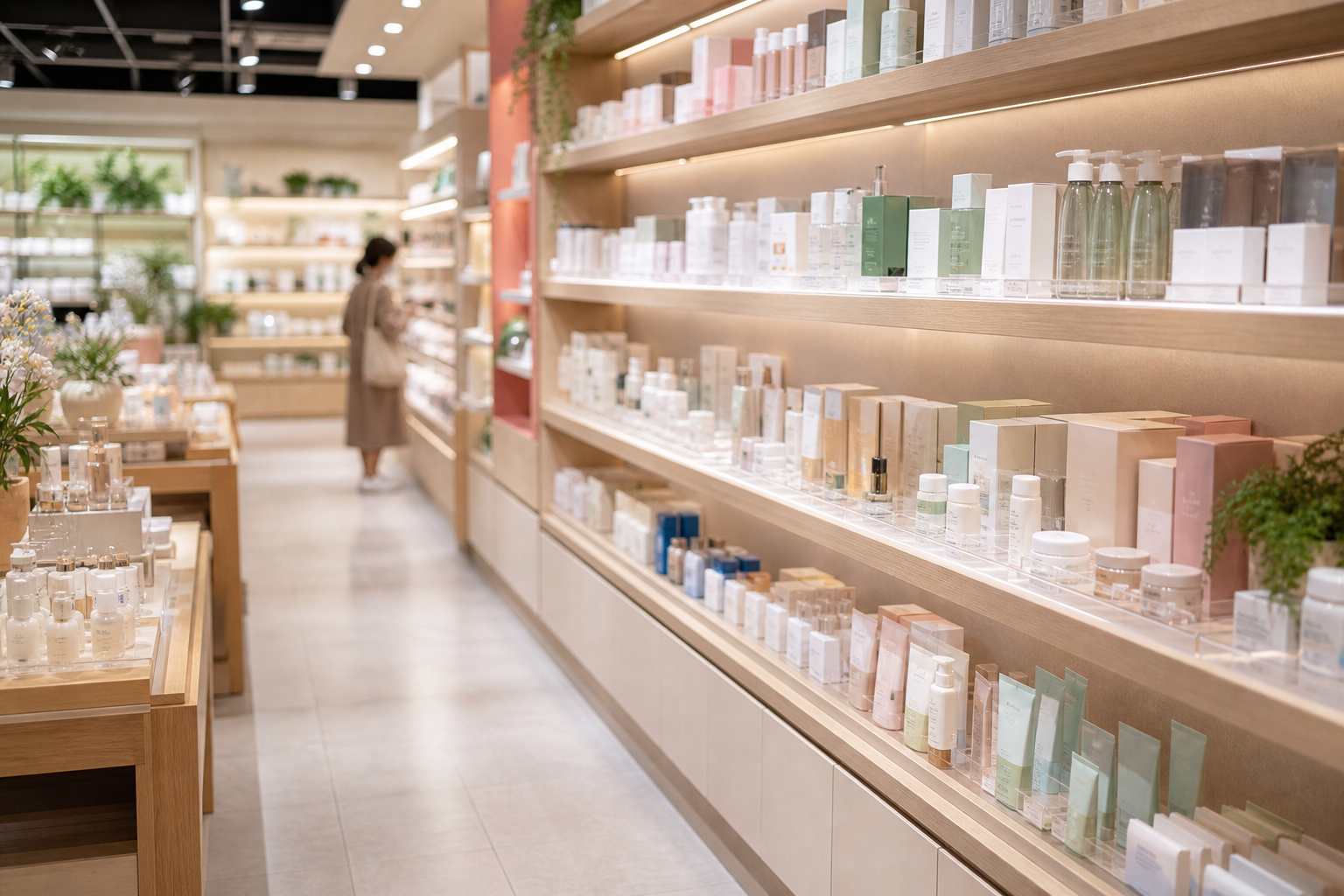
Picture this: you’ve just walked into an Olive Young (Korea’s biggest beauty retail chain) and a store clerk approaches to ask if you need help. Here’s how these words might actually come up in conversation:
"Is your skin a bit sensitive?"
"Yes, I'm looking for a low-irritation/gentle product."
"This product has a soothing/calming effect."
"How's the moisturizing effect?"
"Yes, it's an essence type, so it absorbs quickly."
"Do you have one with a brightening effect too?"
"Try this ampoule — it's also good for elasticity/firmness."
"I'll also buy a sheet mask — I'll look at the all-in-one products later."
Bonus phrases to save for your next K-beauty run:
- 이거 저자극이에요? (igeo jeojageugieyo?) — “Is this low-irritation/gentle?”
- 진정 제품 추천해 주세요. (jinjeong jepum chucheonhae juseyo.) — “Please recommend a soothing product.”
- 수분 크림 있어요? (subun keurim isseoyo?) — “Do you have a moisturizing cream?”
- 미백에 좋은 에센스 있나요? (mibaege joeun esenseu innayo?) — “Is there a brightening-effective essence?”
- 탄력 앰플 써도 될까요? (tallyeok aempul sseodo doelkkayo?) — “Can I try a firming ampoule?”
Even just recognizing these words on a shelf (without saying a word out loud) will make shopping — in store or online — far less overwhelming.