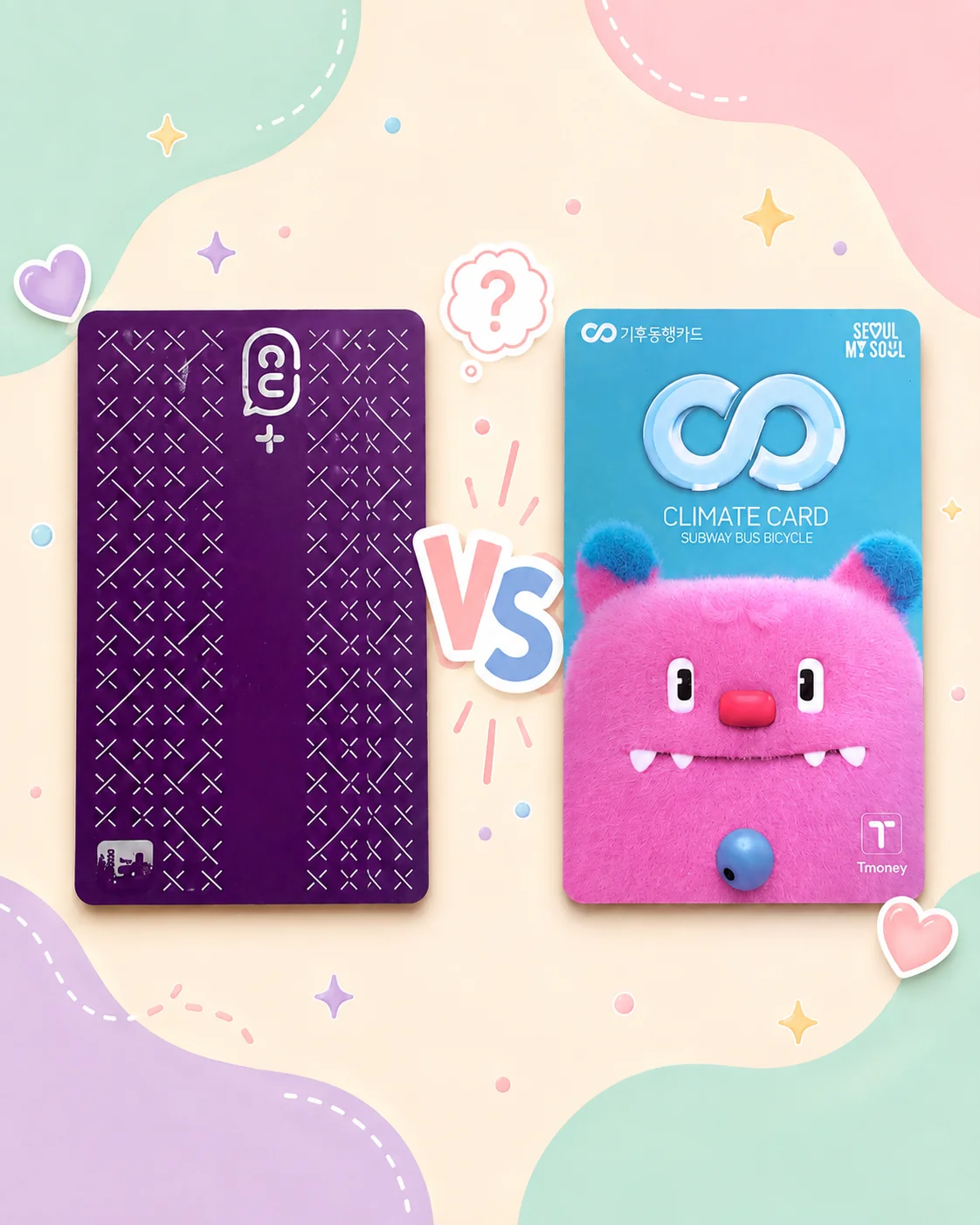
Two 교통카드 (gyotong kadeu), transit card, options come up constantly for anyone visiting Korea: T-money and the Climate Card. They solve different problems — one is pay-as-you-go and works everywhere in the country, the other is an unlimited pass that only works in Seoul. Which one you actually want depends entirely on your trip. We own both ourselves, and picked the Climate Card back up on our most recent Seoul trip — it was genuinely worth the purchase.
T-money Card: the nationwide default
T-money is Korea’s standard rechargeable transit card, and it’s the one you’ll want regardless of what else you get, because it’s accepted far beyond just transit: subway, bus, and taxi fares nationwide, plus purchases at convenience stores, cafes, and many attractions. It works across every major city — Seoul, Busan, Daejeon, Daegu, Gwangju — not just the capital.
Getting one: ₩2,500–₩3,000 at subway stations or convenience stores like GS25 and 7-Eleven. At Incheon Airport specifically, there’s a tourist-oriented variant called the Korea Tour Card for ₩4,000.
Affiliate link — we may earn a small commission at no extra cost to you.
Topping up: cash (won) only, at subway top-up machines or convenience stores — credit cards can’t 충전 (chungjeon) it. Worth keeping cash on hand specifically for this.
Alternatives that exist but matter less: Cashbee works similarly but is Lotte-affiliated and less universally accepted; the Namane Card adds KTX high-speed train payment on top of standard transit, which T-money doesn’t cover. Neither beats T-money for general-purpose use — they’re niche picks for specific needs.
A nice bonus: T-money cards come in a huge range of designs — character collabs, regional and attraction-themed editions, seasonal releases — to the point where collecting different T-money cards is its own small hobby for some visitors and locals alike. If you’re going to be buying one anyway, it’s worth a quick look at what designs are available before grabbing the first plain one you see.
Climate Card: Seoul’s unlimited pass
The 기후동행카드 (gihu donghaeng kadeu) — literally “climate accompanying card” — is built for a different use case: 무제한 (mujehan), unlimited, rides within Seoul over a set number of days, rather than paying per ride.
What it covers: Seoul subway lines, the Gimpo Goldline, and Seoul city/town buses. If you register it on the Tmoney GO app, it also covers Ttareungi, Seoul’s public bike-share.
What it doesn’t cover: the Sinbundang Line, intercity buses, and airport transfers — all common gaps that catch people out when they assume “unlimited” means everything.
Pricing (card itself is roughly ₩3,000, then a pass on top):
- 1 day: ₩5,000
- 2 day: ₩8,000
- 3 day: ₩10,000
- 5 day: ₩15,000
- 7 day: ₩20,000
- 30 day: roughly ₩62,000–65,000 (with youth discounts for ages 19–39)
Buying one: cash only, at convenience stores, metro customer service desks, or directly from ticket machines at Seoul subway stations — we bought ours straight from a station machine, which was quick and didn’t require tracking down a staffed counter. Pickup points also include Incheon Airport and the Myeong-dong Tourist Information Center. It can’t be pre-purchased online, and validity starts the moment you first use it, not when you buy it.
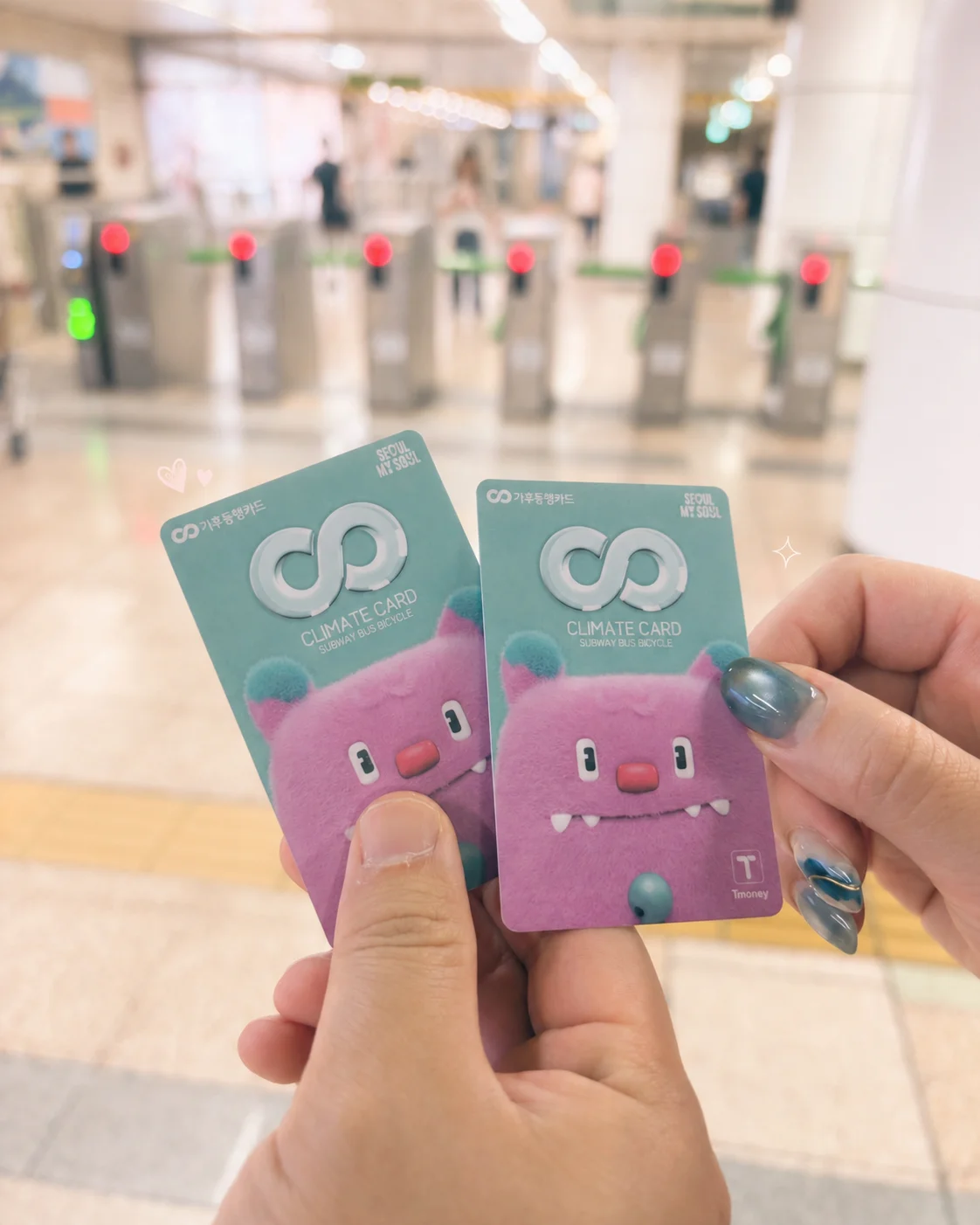
That’s ours, picked up right at the gate line before heading in — one each, so we could both tap through separately rather than sharing a single card back and forth.
One important 2026 change: the 30-day pass for Seoul residents is being phased out in favor of “Climate Card Plus” / K-Pass. If you’re a short-term visitor, this doesn’t affect you — the 1–7 day tourist passes are unaffected and still work exactly as described above.
Which one do you actually need?
For most visitors, the honest answer is both, used differently:
- Buy T-money first, always. You need it for taxis, convenience stores, and any city outside Seoul, and it works as a normal pay-as-you-go transit card everywhere, Seoul included.
- Add the Climate Card only if you’re doing several days of heavy sightseeing concentrated inside Seoul, where the ride volume justifies an unlimited pass over paying per 환승 (hwanseung), transfer, on T-money.
- Skip the Climate Card if your trip involves day trips outside Seoul, airport transfers, or the Sinbundang Line specifically — the coverage gaps will have you reaching for T-money anyway, making the pass a wasted cost.
A quick gut check: if you’re mostly parked in Seoul for 3+ days of subway-heavy sightseeing, the Climate Card likely pays for itself — that was exactly our situation on our most recent trip, and it held up in practice, not just on paper. If your trip is more scattered — day trips, taxis, other cities — just stick with T-money and don’t bother with the pass.